Showing posts with label SPX hydraulic torque wrench. Show all posts

Monday, 16 September 2019

Low Profile Hydraulic Cylinders

This is a small hydraulic cylinder type used to move loads in situations where there is low clearance. They come in three types. The first comes with the same shape as an ordinary hydraulic cylinder but with a shorter length. These are simply referred to as ‘low profile’. The second one is ovular and is called a flat jack. The third comes with the ordinary shape only with a large radius thus the name pancake jack. The last two, the pancake and flat jacks, can have really low profiles in the range of 1.3 inches. 


These single-acting, spring-return cylinders are intended for applications where high power and low generally tallness are necessities. Perfect for bracing installations where space is constrained. The delegated cylinder makes them ideal for fueling lash clips, linkages or for direct contact with the workpiece. 

Hydraulic cylinder bodies are heat-treated utilizing a unique procedure for extraordinary wear and erosion opposition. Three sizes to browse – the biggest being just 2" high – with most extreme powers extending from 4,920 lbs. to 22,150 lbs. Every cylinder has a worked in substantial spring for a quick return and unfeeling cylinder for long administration life.


Features of Low Profile Hydraulic Cylinders 

  • Low overall height
  • Bronze plated piston
  • Piston rod wiper seal
  • Heavy-duty return spring
  • Heat treated and plated cylinder body
  • Single-acting
  • Power-Tech™ treated the body for long wear and corrosion resistance

Tuesday, 11 June 2019

Power Team Hydraulic Cylinder By GGHYD

SINGLE ACTING OR DOUBLE ACTING Hydraulic CYLINDER


Available in multiple varieties of industries and materials, these cylinders will have qualities suited for the utilization at hand. The C-series is a general purpose, single acting spring return cylinder that’s strong and used for connections and pressing. The RSS series is given as double or single acting for 10-250 tons and functions well in limited spaces. The RLS model, for 5-150 tons provides a low-profile, fast piston return. The RA cylinder series, for 20-100 tons, is aluminum to resist damage and corrosion. The CBT series, for 5-25 tons, has joined cylinder collars and secure mounting abilities.

LOAD RETURN AND HIGH TONNAGE CYLINDERS

Of the two R Series available, the 55-565 ton single acting load power team hydraulic cylinder features low series, pressure return and plated cylinder rods. This series’ 100-565 ton double acting cylinder gives a hydraulic return, low cycle, and built-in security relief valve. The RL Series 55-565 ton single acting cylinder has load revenue and locking collar abilities, along with blow limit signals and coated cylinders.  

Read more about power team hydraulic cylinder 


Friday, 31 May 2019

Hydraulic Pump Selection Guide


The pump is the heart of your hydraulic system, generating the flow that converts mechanical energy from a motor or human force into hydraulic energy. Without a pump, the hydraulic system would not work.

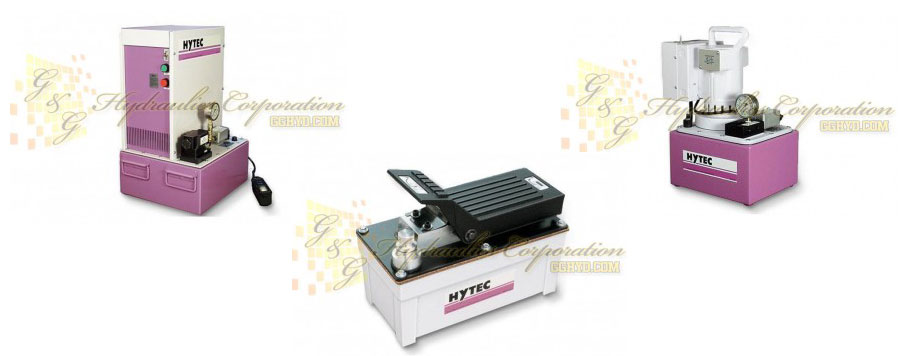
Power Team has a wide selection of manual and air operated pumps, as well as a gasoline engine and electric powered models. The manual pumps, with reservoirs, come in single and 2-speed models. There are the smaller, portable models for powering hand tools, as well as the larger ones more suited to powering cylinders.

The compressed air operated pumps, which require much less effort from the operator then hand pumps, also come in one and two-speed, as well as single and double acting models. Here are some of the standout features and special qualities of the pumps available from Power team;

Features and special qualities

      The fiberglass handle on the manual 2-speed hydraulic pump ensures greater rigidity and reduces operator fatigue. With a more reliable digital pressure gauge, the pump also has an  angled fill port that makes it easy to refill from both vertical and horizontal positions,
     There are also manual 2-speed models that replace handle with foot control, which also reduces operator fatigue. There is even a lightweight model, with a more durable aluminum reservoir and which provides more efficiency and lower handle force,
      Both the 1-speed and double acting air pumps are lightweight and portable, have  permanently vented caps and feature internal relief valves that protect internal components,
      The electric pumps in the Power Team range are designed for heavy duty applications and extended cycle operations of up to 40T. The pumps start and operate under full load and have an electrical a shutdown that stops the pump from restarting unintentionally after interruption caused by a power cut,
      There are also special application pumps, like the compact torque wrench pump that is light and portable and can be operated in either vertical or horizontal positions, and the infinite stage pump that can drive as many as four hydraulic tools simultaneously.

How to select the right hydraulic pump for your needs

For something that is such a critical component of your hydraulic system, your pump selection needs to be carefully considered. There are several factors you must consider if you are going to avoid disappointments and production delays. Let’s look at them;

       The nature of the application. There are general purpose manual pumps used to power all manner of hand tools, specialist ones like torque wrench pumps, as well as larger pumps rated for heavy duty work,
      Power availability. If you are working in remote locations where you have no access to electric power, you may have no choice but to just use manual pumps,
      Related to the above, you will require different types of power team hydraulic pumps for systems that handle heavy loads but operate intermittently, those that actuate a cylinder at lower pressure and then suddenly have to power a bending or lifting task that requires considerably more hydraulic energy, and those for applications that require a double acting cylinder,
     Flow rate requirements. Basically, the higher the required flow rate, the larger the needed pump size,
     The pump must match the oil requirements of the cylinder the hydraulic system is using. The general rule of thumb is to choose a pump with a 15% oil capacity buffer,
     Pressure conditions at both the inlet and outlet ports of the pump. This also determines what size pump you will need.


Sunday, 19 May 2019

Advantages And Disadvantages of Power Team Hydraulic Pump

Power Team Hydraulic Pump offers a few distinct frameworks for dealing with an assortment of good conditions. Effective applications have included setting profundities going from 500 to 19,000 ft and creation rates differing from under 100 to 20,000 B/D. Surface bundles are accessible utilizing multiplex siphons going from 15 to 625 hp. The frameworks are adaptable on the grounds that the downhole-siphoning rate can be directed over a wide range with liquid controls superficially.

Synthetic substances to control erosion, paraffin, and emulsions can be infused downhole with the power liquid, while new water can likewise be infused to break down salt stores. While siphoning substantial crudes, the power liquid can fill in as a viable diluent to diminish the consistency of the created liquids.

The hydraulic pump has the following advantages -


  • Being able to circulate the pump all through the well is the most evident and critical element of a water-powered pump. It is particularly alluring on seaward stages, remote areas, and populated and horticultural territories. 

  • Positive-displacement power team hydraulic pumps are equipped for siphoning profundities to 17,000 ft and more profound. Working liquid dimensions for fly siphons are restricted to around 9,000 ft.

  • By changing the power-liquid rate to the siphons, generation can differ from 10 to 100% of the pump limit. The ideal speed extend is 20 to 85% of appraised speed. Working life will be fundamentally diminished if the pump is worked over the greatest evaluated speed.

  • Digressed wells ordinarily a present a couple of issues to pressure driven free siphons. Fly siphons can even be utilized in through flowline establishments.

The hydraulic pump has the following disadvantages -

  • Removing solids from the power liquid is significant for positive-displacement pumps. Solids in the power liquid additionally influence surface-plunger pumps. Stream pumps, then again, are extremely tolerant of poor power-liquid quality. 

  • Positive-displacement pumps can pumps from a low BHP (< 100 psi) without gas obstruction and different issues. Jet pumps can't pump from such low admission weights, particularly when not exactly the cavitation weight. Fly pumps require roughly 1,000 psi BHP when setting at 10,000 ft and around 500 psi when setting at 5,000 ft. 
Read more about power team hydraulic pumps


Monday, 29 April 2019

Buy The Advanced Hydraulic Solenoid Valve From GGHYD


Solenoid valve mainly comprises of the solenoid and magnetic core. The electromagnetic part of the solenoid valve is made out of the fixed iron center, moving the iron core and coil, and the valve body is normally made out of the slide valve center, slide valve sleeve, and spring base. At the point when the solenoid loop is controlled on or off, the development of the magnetic core will correspondingly control the progression of the liquid to alter its course. Furthermore, the Hydraulic Solenoid Valve is introduced legitimately on the valve body, which is encased in the fixing tube, framing a reduced mix.

At the point when the direct acting solenoid valve is powered on, the electromagnetic power delivered by the solenoid coil will lift the closure part from the valve situate, at that point the valve open. At the point when the power is off, the electromagnetic power will vanish and the closure part will be pushed on the valve situate by spring, at that point the valve closes.

Read more about Hydraulic Solenoid Valve

Monday, 25 March 2019

Power Team Hydraulic Cylinder


Wherever there is a bit of substantial gear, someplace in there ought to be a cylinder, and the pressure driven alternative is regularly the most pragmatic. They are the actuator or mover in a hydraulic cylinder framework. To ensure you don't go going around town when your costly apparatus is sitting inactive, we have taken a gander at basically all applications and gave the privilege water powered barrel to it. You will locate our wide choice of hydraulic cylinders entirely thorough, regardless of whether your application includes pulling, lifting, bringing down, or pushing something.  All power team hydraulic cylinder are date coded and stamped with a maximum pressure rating and capacity. Cylinder bored are roller burnished to harden and smooth the surface, improving seal life by 30%. Cylinder bodies are made with solid steel or aluminum. Read more about power team hydraulic cylinder

Saturday, 9 March 2019

SPX Hydraulic Torque Wrench


Hydraulic torque wrenches are spectacular bits of gear and crucial staples of any device set exactly in light of the fact that they give you such a tight fit, that ensures wellbeing to administrators and steady quality items falling off the creation lines. Be that as it may, that tight fit can exhibit difficulties with regards to fixing the hardware, particularly when the nuts have rusted to due over an introduction to dampness. Whether you’re looking for high-pressure cylinders, pumps with specific reservoir capacities, tensioners or spx hydraulic torque wrench to overcome space restrictions or custom presses, we will design and manufacture a custom product exactly to your requirements. SPX flow now manufactures an expansive catalog of products that range from a hydraulic wrench, inflatable jacks, clamping components, separators and heat exchangers, cylinders and valves, homogenizers, to hydraulic accessories. Read more about spx hydraulic torque wrench


Tuesday, 22 January 2019

Power Team Hydraulic Pump


Hydraulic pumps are essential tools in order to pump liquid into the pump's own outlet. There is various type of hydraulic pump. Gear pumps, vane pumps, and piston pumps area unit the foremost styles of hydraulic pumps.

 I. Gear pumps - uses gears to pump fluid by displacement - power team hydraulic pump area unit one in every of the foremost common styles of pumps. There area unit many blessings and downsides to gear pumps. the benefits area unit high speed, air mass, and quiet operation. The disadvantages area unit the utilization of 4 bushings within the liquid space and stuck finish clearances.

II. Rotary vane pumps - a positive-displacement pump. They embrace a hoop mounted within a cylindrical case. There area unit variety of radial slots during which slippy vanes area unit placed. Mounted to the case is that there and also the vanes area unit designed to press against the wall of the case. Hydraulic pressure or spring force or force because the ring is turned can cause the vane to be forced against the wall.

III. Axial piston pumps - a positive displacement pump. There area unit many pistons in an exceedingly circular arrangement in an exceedingly engine block.

IV. Radial piston pumps - a circular arrangement of hydraulic pistons, and valves which permit pressures bigger than 650 Bar to be reached.

V. Screw pumps - a positive displacement pump. Have one or a lot of screws that rotate to transfer high or low consistence fluids on Associate in a Nursing axis.

Read more

Monday, 7 January 2019

Best Power Team Hydraulic Pump In India


It is very imperative for you to realize that a hydraulic pump is an extremely crucial segment of development, fabricating, and machining hardware. It is in charge of a machine's exactness, its proficiency, and generally speaking execution of a whole framework. Different materials are utilized in a power team hydraulic pump to limit wear and give predictable execution. The sort of material utilized fluctuates as per weights and temperatures that a hydraulic system will experience.


power team hydraulic pump

While picking a hydraulic pump, it is prescribed to consider factors like working weight, temperature, and recurrence. For applications requiring insignificant weights, more affordable, low-weight siphons are accessible. Prior to choosing any kind of hydraulic pump, it is fundamental to consider a couple of exceptionally important focuses like working weight, temperature, and its recurrence. There are more affordable, low-weight models which will unquestionably give attractive answers for a few applications that require negligible weights (under 200 psi). This sort ought not to be considered for substantial modern tasks. Read more

Tuesday, 11 December 2018

Using And Caring Of Torque Wrenches


A torque wrench is used when the user needs a nut, screw, or bolt to be tightened to a specific torque to prevent over tightening and under tightening. The click-type torque wrenches are popular for small application. The torque is set through a dial on the wrench. The unit clicks when the nut is tightened at the set torque.

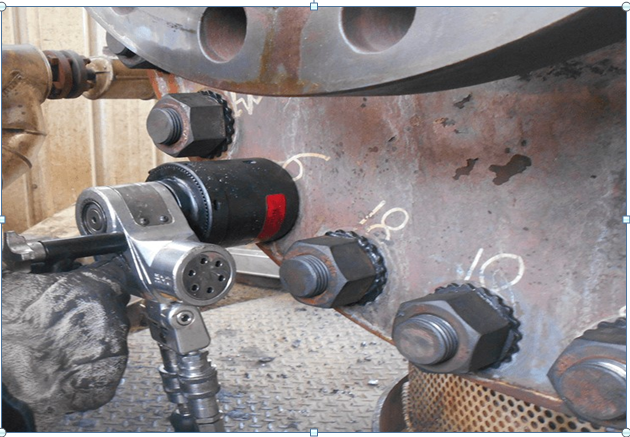
Hydraulic torque wrenches are used in larger applications such as skyscrapers, bridges, mining, aviation, and much more. Before these existed, pneumatic impact wrenches were used. They were much heavier, louder, and not as accurate as hydraulic torque wrenches. Bolt tensioners are also an alternative, but are not commonly used.


[torque wrench application image]

Hydraulic torque wrenches can be dangerous without proper caution. When torque is applied, the wrench pushes its reaction arm up against the infrastructure to prevent the wrench from rotating while it tightens. Workers unaware of this may pinch their fingers.

Not all hydraulic torque wrenches have a reaction arm (see below). These are meant to be used when reaction washers are present (see below). Reaction washers are used between the nut and the infrastructure and fit with its manufacturer’s torque wrench to provide a stationary object that prevents the wrench from rotating. The washer design is typically proprietary, so only a specific wrench may be used.


[reaction washer image]


[torque wrench no arm image]


Two common hydraulic torque wrench designs are the square drive (seen above) and low-profile design (see below). Both can be used with a reaction washer. The difference comes to the application. If there is plenty of space to access the application, a square drive is most beneficial because it can be used with cheaper drive head sizes than low-profile design’s driver (sometimes called links or cassettes).

[how torque wrench works]


Drive heads are the wrench-like part of the unit, so make sure the correct size is used for each nut being tightened or the nut may be damaged, have inaccurate torque, or even injure the operator. Usually, no special tools are needed to exchange drive heads.

Links or cassettes are used with low profile torque wrenches to screw nuts down. These are more costly than square drives; however, it is possible to substitute a new link size with an insert (sometimes called reducers) for your current link.


When tightening an already tightened bolt, you must loosen the bolt before proceeding due to inertia. Inertia is the tendency of an object to resist change in motion. The bolt will require more force to start the tightening than the actual torque currently applied to the bolt.

Can A Torque Wrench Loosen Bolts?

It is not necessary to use a torque wrench to loosen bolts. Bolts work as they do because the steel is trying to compress after you have stretched the bolt by tightening. This combined with heat cycles and debris can require more torque to remove the bolt than was used to tighten it. Exceeding the max torque limit of your wrench can compromise its accuracy. However, loosening bolts usually requires less torque because the pitch of the threads on bolts acts like a wedge. This wedge is being squeezed, and this helps the bolt be removed.


Torque Wrench Pumps

In order to use your hydraulic torque wrench, you will need to power it. First, inspect your equipment for cracks, leaks, damage, debris, etc. Make sure to check electrical, mechanical, pneumatic, and hydraulic components. Then, connect your torque wrench to the pump using your hose. Choose your torque setting (method and technique vary by manufacturer). Then, test that it is working. When you are done tightening a nut, remember to release the pressure.

How To Calibrate Torque Wrenches

At some point, your hydraulic torque wrench will need to be calibrated. The frequency to which you should calibrate depends on a number of factors:
·         Desired accuracy
o   You may need to comply with certain industry standards
·         Usage (frequency & improper usage)
o   You may need to comply with certain industry standards
·         Storage
o   If you use a torque wrench with a spring, you must lower the setting before storage
·         Environment
o   A wet environment may cause internal rusting
o   A hot environment may cause a change in lubrication
Contact your nearest calibrator for consultation and service. Order SPX hydraulic torque wrench